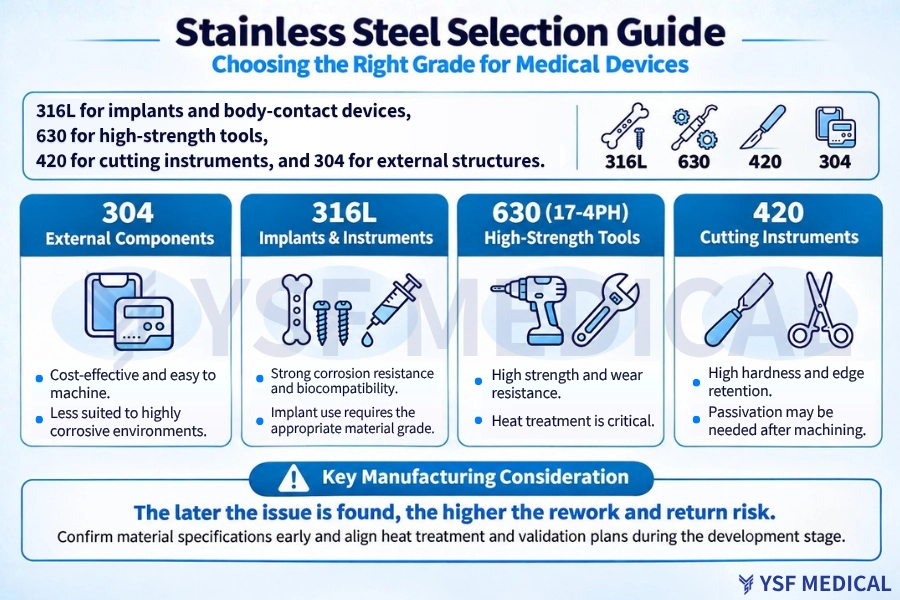
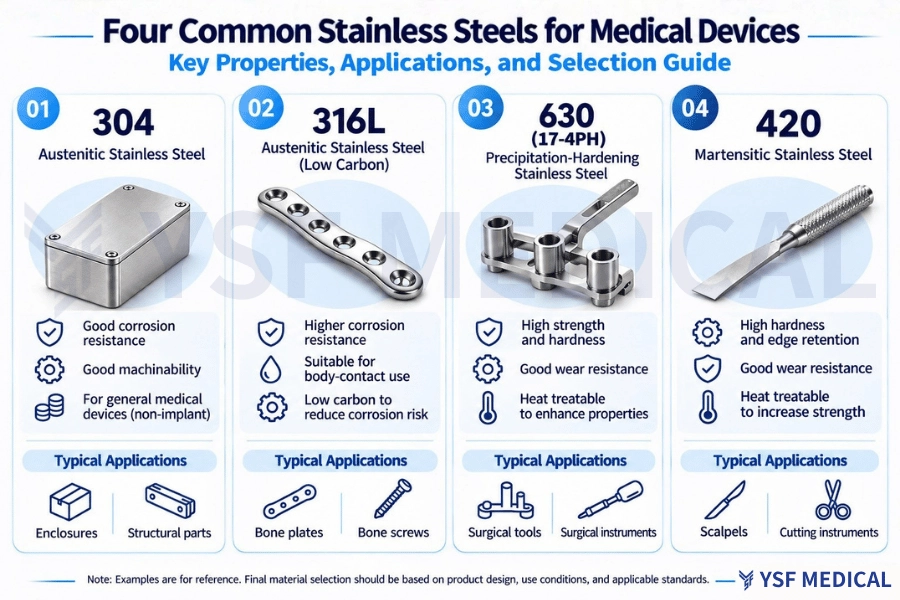
Four stainless steel grades show up again and again in medical devices. 316L is the go-to for implants and instruments that contact body fluids, 630 for high-strength surgical tools, 420 for osteotomes and scissors, and 304 for enclosures and structural parts. Picking the wrong grade in an OEM project can lead to rejected samples, rescheduled testing, and delayed regulatory submissions. This guide covers the standards, properties, and practical considerations for each grade to help purchasing and R&D teams make the right call early.
Stainless steel is widely used in orthopedic implants, surgical instruments, and medical equipment components. But each grade has its own properties and standards.
“Medical grade” is not a single certification. Stainless steel in a medical device must meet the standard that matches its intended use, such as ASTM F138, ASTM F899, or ISO 5832-1, backed by traceable material certifications.
1.1 Three Key Properties of Stainless Steel
Stainless steel is an iron-based alloy with at least 10.5% chromium. Chromium forms a very thin oxide layer on the surface that repairs itself when damaged, giving the material reliable corrosion resistance. The medical device industry relies on it for three main reasons:
Corrosion resistance: It holds up to body fluids, cleaning agents, and repeated autoclave sterilization.
Strength and machinability: Depending on grade and heat treatment, it delivers structural strength, edge hardness, and efficient machining.
Cost and supply stability: It costs less to buy and machine than titanium alloys, and the supply chain is well established.
1.2 Five Things to Evaluate Before Selecting a Grade
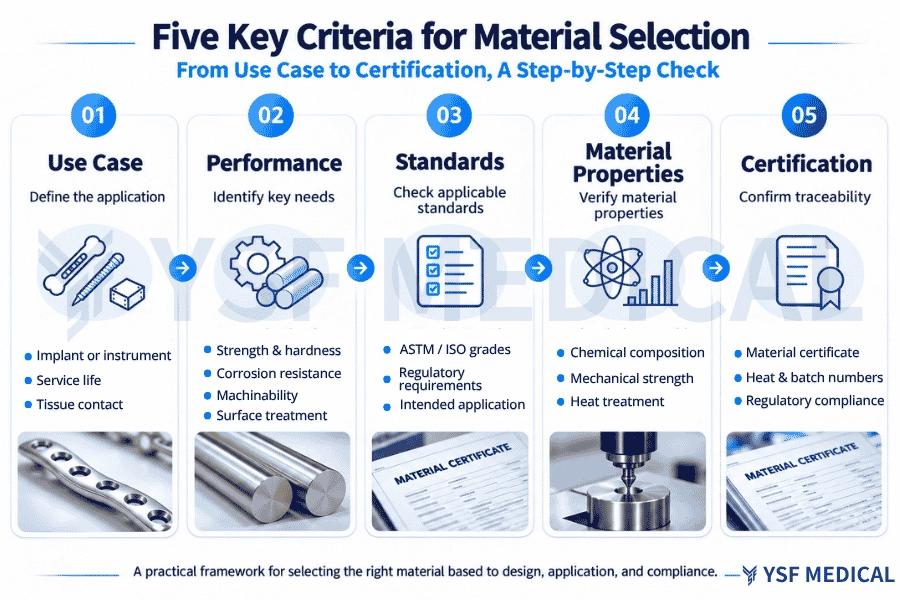
Work through each factor, from use case to material certification:
1.2.1 Use case: The higher the risk, the stricter the biocompatibility and corrosion requirements. Devices fall into three groups: implantable (bone screws, bone plates), invasive (surgical instruments), and non-implantable, non-invasive (enclosures, structural parts).
1.2.2 Material performance: Pick the grade based on what the part needs. Choose 630 for high strength, 420 for a sharp cutting edge, 304 for general-purpose machining, and 316L for implants or contact with body fluids. 1.2.3 Applicable standard: The same grade may fall under different standards depending on whether it goes into an implant or an instrument.
1.2.4 Chemistry and mechanical properties: Molybdenum improves pitting resistance in chloride environments, and lower carbon reduces the risk of intergranular corrosion. Tensile strength and hardness must meet the drawing requirements.
1.2.5 Material certification: Certs should trace back to the heat number, lot number, and material source, and serve as a key indicator of how well a supplier manages its materials.
Bone screws, bone plates, instruments in contact with body fluids
★★★★★
★★☆☆☆
630
Precipitation hardening
Surgical tools, guides, high-load structural parts
★★★☆☆
★★★★☆
420
Martensitic
Osteotomes, scissors, cutting-edge components
★★☆☆☆
★★★★★
左右滑動看表格
Microstructure
Key Characteristics
Representative Grades
Austenitic
Corrosion resistant, ductile, non-magnetic when annealed; not heat treatable.
304、316L
Precipitation hardening
High strength after aging; moderate corrosion resistance.
630
Martensitic
Hardens by quenching; holds a sharp edge; lower corrosion resistance.
420
2.1 304 Stainless Steel: A Cost-Effective Choice for Non-Implant Structural Parts
Common standards: ASTM A276, ASTM A240 Properties and applications: 304 is an austenitic grade that forms and machines well, with steady supply and manageable cost. It is used for enclosures, equipment parts, and other structural components that don’t contact body fluids. Without molybdenum, it resists pitting less in chloride environments.
Purchasing and manufacturing notes: When switching a non-critical structural part from 316L to 304, call out surface finish requirements on the drawing up front. Parts regularly exposed to cleaning agents or repeated sterilization may rust sooner, raising warranty and complaint costs.
2.2 316L Stainless Steel: A Common Choice for Implants and
Fluid-Contact Instruments
Common medical standards: Implant grade ASTM F138, ISO 5832-1; instrument grade ASTM F899 Properties and applications: 316L builds on 304 by adding molybdenum and keeping carbon at or below 0.03%. It offers good biocompatibility and resists corrosion from body fluids, making it well suited for bone screws, bone plates, and invasive instruments. Its yield strength is lower than 630, so it is less suited to parts that carry very high loads 316L vs. 316LVM The difference comes down to melting process and material cleanliness: 316L: A low-carbon, molybdenum-bearing grade commonly used for surgical instruments. When it meets an implant-grade standard such as ASTM F138, it can also be used for orthopedic implants. 316LVM: Produced through vacuum induction melting and vacuum arc remelting (VIM-VAR), which greatly reduces non-metallic inclusions. The cleaner material has better fatigue strength and is used for high-reliability implants such as bone screws and plates.
Purchasing and manufacturing notes: Industrial-grade 316L is not implant-grade material, and 316LVM still needs to be verified against ASTM F138 or ISO 5832-1. Check material certs, chemistry, and inclusion ratings, and confirm the heat number is traceable. Bar stock with out-of-spec inclusions can show small pits after electropolishing, leading to failed inspections, remade samples, and missed delivery dates.
2.3 630 Stainless Steel: For High-Strength Tools and Guides
Common medical standards: ASTM F899, ASTM A564 Properties and applications: Also known as 17-4PH or SUS630, this precipitation-hardening grade is usually machined in the solution-treated state (Condition A), then age-hardened for high strength and hardness. Its corrosion resistance is similar to 304. It works well for surgical tools, guide fixtures, drill sleeves, and parts that handle high torque, repeated stress, or heavy loads.
Purchasing and manufacturing notes:
Specify the heat treatment condition: The drawing should state the condition, such as H900 for high strength or H1150 for higher toughness. Inconsistent furnace airflow and temperature can cause uneven hardness within a batch, adding time and cost for 100% inspection and sorting.
Aging shrinkage and dimensional control: 630 shrinks slightly after aging, roughly 0.04% to 0.06% for H900. For tolerances of ±0.02 mm or tighter, either build in shrinkage compensation during machining or finish critical dimensions after heat treatment by grinding or light CNC passes.
2.4 420 Stainless Steel: Keeping Osteotomes and Scissors Sharp
Common medical standards: ASTM F899, ISO 7153-1 Properties and applications: After heat treatment, this martensitic grade reaches high hardness and holds a sharp edge for a long time. It is common in cutting instruments such as osteotomes and tissue scissors. Its corrosion resistance is lower than 316L.
Purchasing and manufacturing notes: 420 should be passivated per standards such as ASTM A967. A contaminated bath or drifting parameters can cause flash attack, leaving the surface dark and rough and requiring reprocessing before shipment. Finished parts stored in humid conditions are also prone to localized rust. Since parts tend to distort after quenching, cutting edges and mating dimensions are usually ground after heat treatment, using dedicated fixtures to control distortion while keeping both accuracy and sharpness.
YSF Medical brings more than 30 years of precision machining experience to OEM manufacturing of orthopedic implants, surgical instruments, and precision medical components. We are certified to ISO 13485:2016, and every step from incoming material through machining and surface finishing is traceable by heat and lot number.
For 304, 316L, 316LVM, 630, and 420, we can help evaluate material specs, heat treatment, and passivation requirements early on, then take your project from prototyping and precision machining through mass production.
If you're looking for an OEM partner for implants, surgical instruments, or precision medical components, let’s talk about your project.
📧 Email us at sales@ysfbone.com or fill out our contact form, and our team will get back to you within 24 hours.
Choosing stainless steel takes more than knowing the grade name. Material standards, use environment, heat treatment, and surface finishing all need to be confirmed. Settling these early and keeping complete traceability records helps OEM projects avoid rework, testing delays, and unexpected costs.
This article is compiled from publicly available information and YSF Medical's hands-on manufacturing experience and is intended for general reference by industry professionals. Specifications and figures provided are for general guidance only; actual project specifications should be verified against drawings and supplier evaluations. For any matters related to medical diagnosis or treatment, please consult a qualified physician. Corrections, feedback, and further discussions with YSF Medical are always welcome.
ASTM International. (2019). Standard specification for wrought 18chromium-14nickel-2.5molybdenum stainless steel bar and wire for surgical implants (UNS S31673) (ASTM F138-19). https://doi.org/10.1520/F0138-19
International Organization for Standardization. (2024). Implants for surgery — Metallic materials — Part 1: Wrought stainless steel (ISO 5832-1:2024). https://www.iso.org/standard/83775.html
ASTM International. (2023). Standard specification for wrought stainless steels for surgical instruments (ASTM F899-23). https://store.astm.org/f0899-23.html
ASTM International. (2025). Standard specification for chemical passivation treatments for stainless steel parts (ASTM A967/A967M-25). https://store.astm.org/a0967_a0967m-25.html
International Organization for Standardization. (2016). Medical devices — Quality management systems — Requirements for regulatory purposes (ISO 13485:2016). https://www.iso.org/standard/59752.html
Q1: Do magnets stick to stainless steel? Is medical stainless steel magnetic?
It depends on the microstructure. Austenitic 304 and 316L are essentially non-magnetic when annealed, though cold working or bending can make them slightly magnetic. Martensitic 420 and precipitation-hardening 630 are clearly magnetic.
A magnet test can’t tell you whether a material is medical grade. That depends on meeting ASTM or ISO standards and having proper material certifications.
Q2: What’s the difference between 316, 316L, and 316LVM? Does a “medical grade” label mean it meets the standard?
“316 medical grade” often appears on tableware and water bottles, but that label doesn’t mean the material is suitable for medical devices. Here’s how the three compare:
316: A molybdenum-bearing austenitic grade with up to 0.08% carbon, used in chemical processing, marine, and food equipment.
316L: The low-carbon version, capped at 0.03% carbon, and less prone to intergranular corrosion after welding.
316LVM: Vacuum melted to further limit inclusions and improve cleanliness, commonly used in orthopedic implants.
For implants, the material must also meet ASTM F138 or ISO 5832-1 and come with traceable certifications.
Q3: Both 420 and 630 can be hardened by heat treatment. How do I choose?
420: Best for cutting instruments that need a sharp, wear-resistant edge.
630: Best for surgical tools that have to handle torque and heavy loads.
Q4: What is passivation, and does every machined medical part need it?
Passivation uses an acid solution to remove trace iron left on the surface after machining, helping a stable passive layer form. The most common standard is ASTM A967. Whether a part needs it depends on its intended use and drawing requirements. 630, for example, is often passivated after machining or heat treatment to reduce corrosion risk. Poorly controlled parameters can cause discoloration, roughness, or localized corrosion.
.webp) Contact Us


.webp) CONTACT US