"How do you manage IQC? How often is IPQC performed? What sampling criteria do you apply for FQC?"
These are the questions procurement and R&D teams ask when seriously evaluating a contract manufacturer, and they're the right ones to ask.
In precision medical device machining, quality isn't verified at the end. It's managed at every stage. When dimensions drift toward tolerance limits during machining without timely correction, an entire batch can be compromised. In orthopedic applications, a 0.05 mm deviation in a bone screw isn't just a measurement issue, it can affect fixation stability and clinical outcomes.
A clean final inspection report only tells part of the story. What matters more is how a manufacturer controls quality between receiving materials and shipping finished parts. IQC, IPQC, FQC, and OQC are the four stages where that control either holds or breaks down.
This guide draws on 30+ years of medical device machining experience to walk through what each stage involves, what to look for in a manufacturing partner, and where gaps most commonly appear, so your team can ask better questions before a process issue becomes a delivery problem."
When evaluating a medical device contract manufacturer, quality control is often the first aspect that teams review. In the medical device industry, it is crucial to clearly distinguish between Quality Control (QC)and Quality Assurance (QA) to accurately assess a manufacturer's ability to maintain consistent performance over time.
1.1 QC vs. QA: What Is the Difference?
Quality Control emphasizes inspection at designated checkpoints throughout the production process. This includes the evaluation of incoming materials, in-process verification, and final product inspection. On the shop floor, calibrated measurement tools, such as thread plug gauges, ring gauges, and pin gauges, are used to verify dimensional conformance. Additionally, microscopes are employed to examine surface conditions, including burrs and tool marks. The objective is to ensure that each part meets the specified drawing requirements and tolerance standards.
Quality Assurance (QA) adopts a system-level perspective. Instead of evaluating individual components, it ensures that the entire manufacturing process consistently produces conforming products through process design, document control, operator training, equipment calibration, and supplier management. In practice, a manufacturer with robust QA does not wait until the Final Quality Control (FQC) stage to identify problems. By that point, reworking or scrapping the batch is often the only option, resulting in costly delays to the production schedule.
1.2 The Four Key Inspection Stages in Medical Device Quality Management
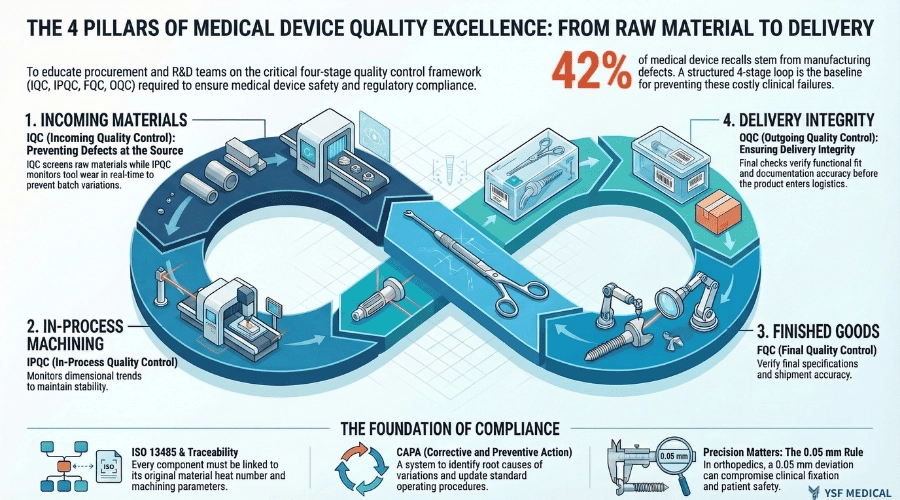
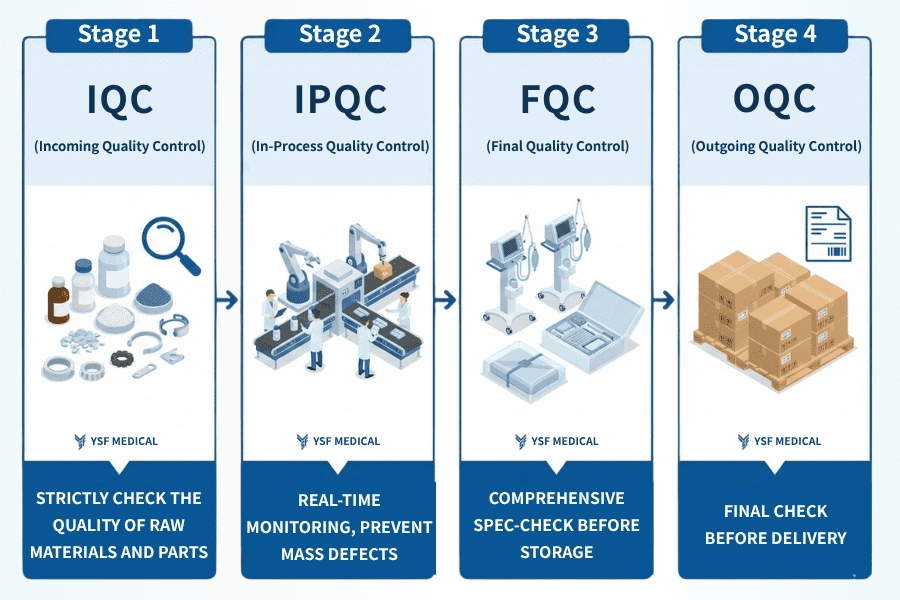
From incoming materials to final shipment, medical devices undergo multiple layers of quality control. This structured approach can be summarized as a straightforward sequence: IQC → IPQC → FQC → OQC, establishing a continuous control framework that ensures product quality from source to delivery.
Inspection Stage
Description
Timing
Inspection Scope
Key Objective
IQC
Incoming Quality Control
Upon receipt of materials
Raw materials, components, and packaging
Verify material certifications and documentation to ensure that only qualified inputs enter production.
IPQC
In-Process Quality Control
During machining operations
Semi-finished parts, first articles, and in-process components
Monitor dimensional trends in real time and apply tool compensation as needed to maintain process stability.
FQC
Final Quality Control
After production or cleaning is complete
Completed parts before packaging
Perform a full inspection or sampling to verify dimensions, surface condition, and overall compliance with specifications.
OQC
Outgoing Quality Control
Before shipment
Packaged Products
Verify labeling, batch traceability, and shipment documentation to ensure accurate and complete deliveries.
On the shop floor, coordination among these four stages plays a critical role. IQC screens incoming materials to ensure a stable starting point, while IPQC continuously monitors process variations and keeps them under control.
When upstream controls are effectively managed, the workload at the final inspection stage becomes significantly more streamlined. This also serves as a practical indicator of how well a manufacturer’s quality system is implemented in daily production.
1.3 Why Medical Device Manufacturing Demands a Higher Level of Quality Control
Medical devices differ from general industrial components in several key ways. Their applications, performance expectations, and regulatory environments place a greater emphasis on consistent and controlled manufacturing. These requirements reflect the nature of the products and their intended use in clinical settings.
1.3.1 Patient safety is paramount, necessitating an exceptionally high level of precision and consistency in every component
In orthopedic applications, even a small burr or slight deviation in a bone screw can compromise fixation stability and impact clinical performance. Surface condition, dimensional accuracy, and overall finish must be meticulously controlled, as minor manufacturing variations can affect the outcome.
1.3.2 Regulatory Requirements and Traceability
Medical device manufacturing operates under standards such as ISO 13485, which require full traceability of every component, from the origin of raw materials and machining parameters to final inspection records.
In practice, traceability extends beyond mere documentation. It offers clear, verifiable evidence that each product has been manufactured under controlled conditions, instilling customer confidence in both compliance and consistency.
1.3.3 High-Quality Responsibility in Medical Device Manufacturing
Product performance and consistency are critically important in the medical device industry. A well-structured quality control (QC) process plays a vital role in ensuring that every product meets expectations before reaching the market.
As a manufacturing partner, the focus is on identifying and managing potential risks within the facility to ensure a smooth and reliable transition from production to clinical use.
Incoming Quality Control (IQC) serves as the initial checkpoint in the quality system and plays a critical role in establishing a stable production baseline. Although often underestimated, it directly impacts the consistency of downstream processes.
Many OEM teams assume that specifying compliant materials is sufficient to ensure product quality. However, in practice, even when using the same supplier and identical material certifications, incoming materials can exhibit variations. Therefore, verification at the receiving stage remains essential to maintain consistency in medical device manufacturing.
2.1 What Is IQC and Why Does It Matter?
Incoming Quality Control (IQC) involves the inspection and verification of raw materials, components, and packaging before they are released into inventory and production. Its purpose is to ensure that materials meet defined specifications before entering the manufacturing process, thereby supporting stable and efficient downstream operations.
During pilot production, a customer reported an unexpected issue with thread fit. A traceability review revealed that when the material batch was changed, the outer diameter of the bar stock had shifted by 0.03 mm. Because this parameter was not included in the IQC inspection scope, the variation was only detected during IPQC, resulting in the first articles from that batch being unusable. Based on this experience, verification of the outer diameter of incoming bar stock is now included as a standard IQC measurement item.
At YSF, material verification extends beyond simply matching the Certificate of Analysis (CoA) with the lot number. We cross-check supplier labels, internal material records, and the actual delivered materials to ensure complete consistency. Additionally, we assess the original condition of the material, including packaging integrity and any signs of oxidation or storage marks on the surface. Even minor dimensional variations or surface imperfections can affect machining behavior and contribute to process variability during CNC milling.
By implementing rigorous dimensional checks and visual inspections during the IQC stage, we establish a stable and consistent baseline for every material entering production.
The value of IQC is clear: it ensures that quality is built in from the very beginning.
2.2 What are the key IQC inspection items in medical device manufacturing?
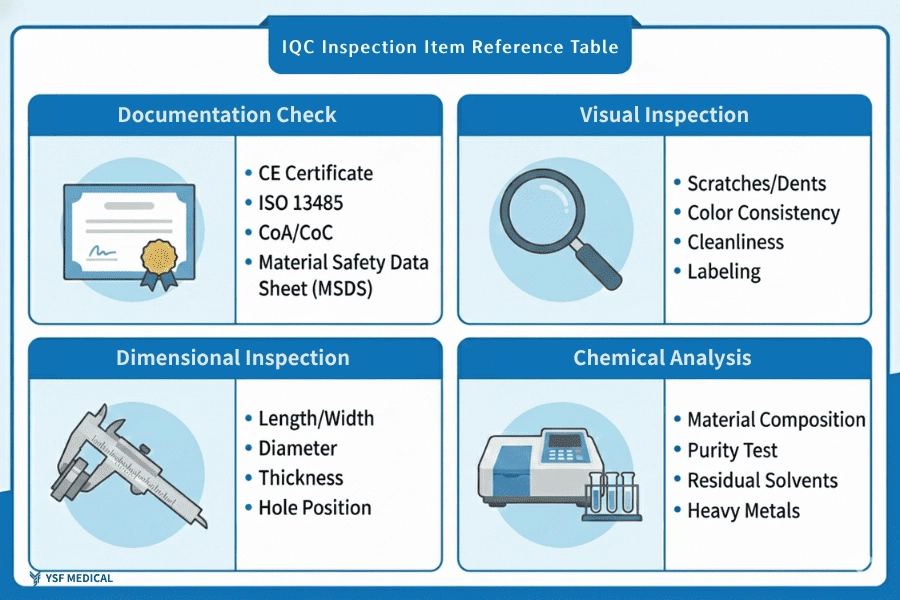
(Figure 2. Overview of IQC Inspection Items)
In medical device machining, Incoming Quality Control (IQC) requirements extend beyond standard manufacturing inspections. In addition to verifying appearance, dimensions, and quantity, it is essential to confirm material compliance and traceability to meet industry standards.
For precision components, the level of detail in Incoming Quality Control (IQC) directly influences the stability of downstream processes. At YSF, a strong emphasis is placed on material traceability and maintaining a consistent machining baseline. This approach is supported by four core verification areas:
2.2.1 Document Verification:
Material certifications are meticulously reviewed to ensure compliance with medical-grade standards, including titanium ASTM F136, commercially pure titanium ASTM F67, and 630 stainless steel commonly used in surgical instruments under ASTM F899 or A564. Lot numbers are cross-checked against delivery records and internal material tracking systems to confirm consistency, while chemical composition and mechanical properties are verified against established specifications.
2.2.2 Visual and Packaging Inspection:
The packaging condition is reviewed to ensure it remains intact and free from moisture exposure. Material surfaces are inspected for rust, deep scratches, or contamination to maintain a clean and stable input for precision machining.
2.2.3 Critical Dimension Verification:
Calibrated precision instruments, such as micrometers, are used to verify critical dimensional tolerances of incoming materials. This ensures consistent clamping performance and stable spindle operation during machining.
2.2.4 Traceability and Identification:
Material markings and labels are verified to ensure that each bar can be traced back to its original heat number. This level of traceability supports regulatory requirements and provides full visibility throughout the production process.
2.2.5 Advanced Material Verification Options:
For projects with stringent quality requirements or additional verification needs, advanced methods such as spectrometer analysis or XRF testing can be employed to confirm material composition.
When detailed verification is required, testing can be conducted through certified third-party laboratories, such as SGS, which provide reliable and independently validated data to support material compliance.
During production, dimensional variations caused by tool wear typically develop gradually rather than suddenly. In IPQC inspections, measurement trends are closely monitored. When consecutive samples approach tolerance limits, tool compensation or replacement is considered, even if the results remain within specifications.
By identifying these trends early, process adjustments can be implemented promptly to ensure stable production and consistent part quality.
3.1 The Core Value of IPQC: Preventing Batch Variations
IPQC focuses on monitoring semi-finished parts and process parameters throughout the machining process. On the shop floor, its value is demonstrated in three key areas:
3.1.1 Preventing Batch Variations
Tool wear causes dimensions to drift gradually rather than abruptly. When consecutive samples trend toward a tolerance boundary, we adjust tool compensation proactively to prevent parts from going out of specification, rather than waiting until the batch is compromised.
3.1.2 Ensuring Process Stability and Repeatability
Producing one good batch is not the goal; the objective is to consistently replicate that quality in subsequent batches. In-process sampling provides continuous monitoring to ensure the process remains stable. If any variation occurs, it is detected early, preventing it from affecting the next production run.
3.1.3 Supporting Continuous Process Improvement
IPQC data feeds directly into process capability analysis, including Cpk, enabling our engineering team to identify which operations present the highest variation risk. When tolerance requirements tighten during a design revision, we already have the data to determine whether the current process can maintain those standards.
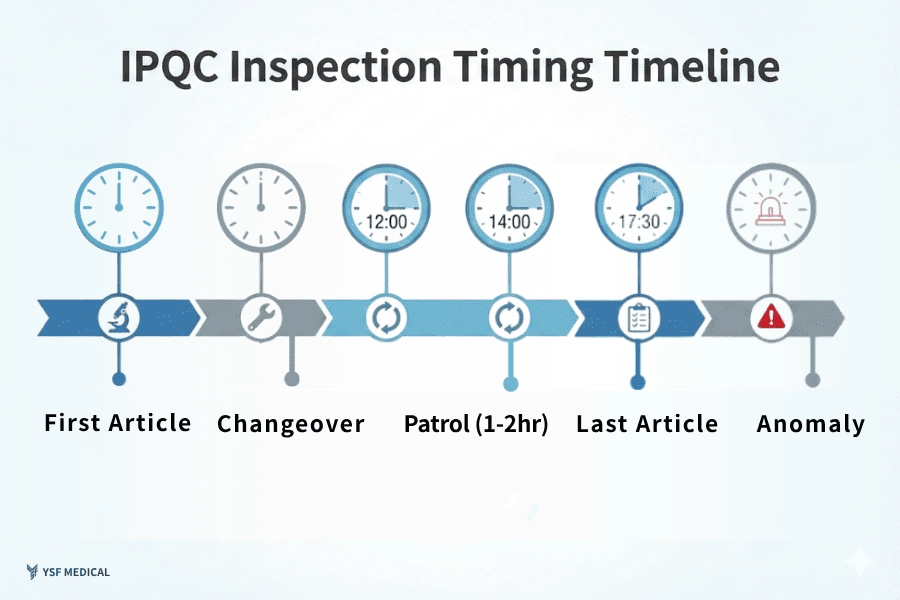
3.2 IPQC Inspection: Timing and Frequency
(Figure 3. Overview of IPQC Inspection Timing and Frequency)
IPQC inspections are structured according to process characteristics, product risk, and historical data, with clearly defined timing and frequency to ensure consistent process control.
3.2.1 First Article Inspection (FAI)
At the start of each batch, and after any tool change or program adjustment, the first three parts undergo full dimensional verification. Production proceeds only after these initial parts meet all drawing specifications, ensuring a stable and controlled starting point for machining.
3.2.2 Operator In-Process Checks
During production, machine operators conduct routine checks on critical dimensions at defined intervals, typically every one to two hours. This frequent verification offers immediate insight into process conditions and helps maintain consistent control at the point of manufacture.
3.2.3 Quality Assurance Patrol Inspections
In addition to operator checks, quality personnel perform independent sampling inspections at defined intervals, focusing on monitoring measurement trends. When values consistently approach tolerance limits, a review is initiated to identify the cause and implement appropriate adjustments, ensuring stable and controlled production.
3.2.4 Post-Interruption Verification
Additional sampling is conducted following events such as equipment interruptions, power restorations, operator changes, or material batch transitions. This step ensures that the process remains under control after a restart and that production conditions continue to support consistent part quality.
3.3 Key Control Considerations in Medical Device Machining
Beyond dimensional verification, medical-grade machining places additional emphasis on the following practices: Material Traceability: Each part is linked to its original material batch and Material Test Report (MTR) Tool Management: Tool condition is monitored to ensure a stable surface finish and consistent performance. Process Documentation: Machining parameters are recorded to ensure consistent, traceable production.
After IQC and IPQC are completed, products enter the final stage before delivery: Final Quality Control. This step ensures that finished parts meet all specifications before being moved into inventory or prepared for shipment.
4.1 Definition and Role of Final Quality Control (FQC)
Final Quality Control (FQC) refers to the comprehensive inspection conducted after all machining processes are completed and before the product is delivered to the customer. Its purpose is to verify that the finished parts fully comply with drawing specifications and established quality standards.
Unlike IPQC, which focuses on monitoring process variations, FQC centers on overall product acceptance. This includes dimensional accuracy, surface condition, final geometry, and labeling compliance. The goal is to ensure consistency across the entire batch, so each part meets expectations at the time of delivery.
Practical Insights: FQC effectively identifies nonconforming conditions when acceptance criteria are clearly defined early in the project. In one instance, a drawing specified a surface roughness requirement of Ra ≤ 0.8 but did not define the measurement direction. This omission resulted in varying measurements for the same part by different parties.
Aligning measurement methods and acceptance criteria during the prototyping stage ensures consistent evaluation and a shared understanding of final quality control (FQC) results at delivery.
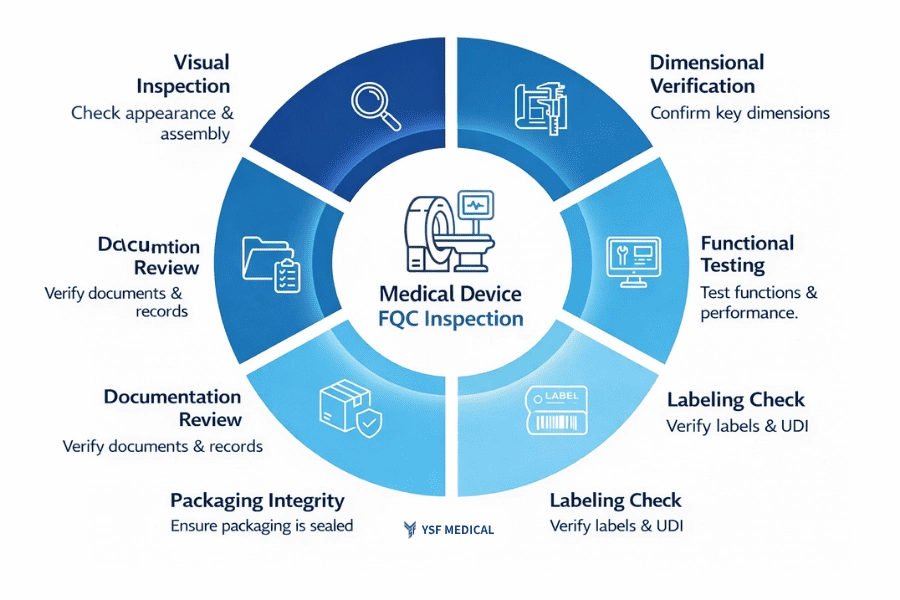
4.2 FQC Inspection Checklist
(Figure 4. FQC Final Inspection Workflow)
4.2.1 Surface Integrity and Cleanliness
Verify that surfaces are free of scratches, tool marks, corrosion, and residual burrs. Ensure there is no cutting oil or machining debris present to facilitate effective downstream cleaning or sterilization processes.
Perform final sampling to verify key features such as mating surfaces, functional diameters, and geometric tolerances, including roundness and flatness. This process ensures proper fit and optimal performance during assembly.
4.2.3 Functional Fit Testing
Simulated checks are conducted based on product design elements, such as thread engagement and locking mechanism operation, to verify consistent functionality in real-world applications.
4.2.4 Marking Verification
Confirm that laser markings, including part numbers and lot identification, are accurate, clear, and durable, and that their placement complies with regulatory requirements.
4.2.5 Documentation Verification
Confirm that all required shipment documents are complete, including inspection reports with recorded measurement data and material certifications. Verify that traceability labels and lot identification are accurate and consistent with the delivered parts.
After the Final Quality Control (FQC) and proper packaging are completed, products proceed to Outgoing Quality Control, the final checkpoint before shipment. This stage involves reviewing the entire shipment to ensure that the quantity, documentation, and protective packaging all comply with delivery requirements.
In medical device manufacturing, documentation accuracy is as crucial as dimensional verification. Ensuring alignment among lot identification, material certifications, and inspection records is essential for traceability and regulatory compliance.
For this reason, documentation review has been established as a dedicated control step within OQC. Each shipment is verified to ensure full consistency across records, enabling customers to access a complete and reliable traceability chain when needed.
5.1 Definition and Role of Outgoing Quality Control (OQC)
5.1.1 Outgoing Quality Control (OQC) Definition
OQC refers to the final inspection conducted before products enter the logistics stage. It involves reviewing the packaging condition, shipping labels, and accompanying documentation to ensure everything is properly prepared for delivery. This step helps maintain a reliable and well-coordinated supply chain.
5.1.2 Delivery Integrity
Customer satisfaction depends not only on product precision but also on packaging quality and the completeness of documentation. OQC ensures that parts are well protected during transportation and that all shipment details are accurate and aligned.
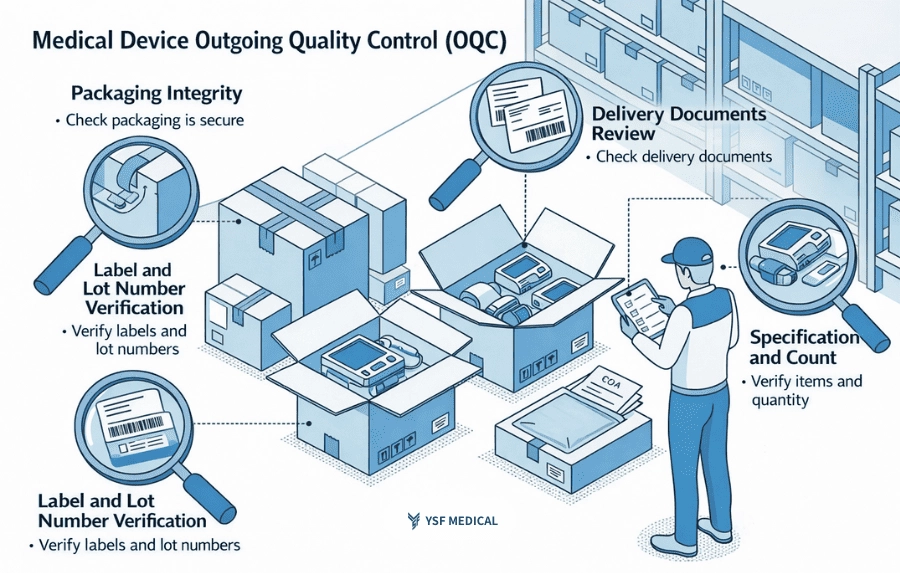
5.2 OQC Inspection Focus and Sampling Criteria
OQC inspection items can be categorized into four key areas:
5.2.1 Protective Packaging Verification
Confirm that outer cartons are intact and well protected against moisture. Ensure that inner packaging, such as trays, bubble wrap, and cushioning materials, is securely in place to maintain part integrity during transportation.
5.2.2 Documentation and Specification Verification
Verify that the packing list matches the actual shipment, including part numbers and quantities. Accurate documentation ensures smooth receiving and enhances traceability for the customer.
5.2.3 Lot Traceability Alignment
Ensure that lot identification is consistent across the product, inspection reports, material certifications, and outer packaging labels. When multiple batches are included in a single shipment, clear segregation and identification are maintained.
5.2.4 Shipping Label and Logistics Verification
Confirm that outer carton labels include accurate delivery details, order numbers, and the total carton count. Ensure labels are clear, scannable, and display appropriate handling instructions, such as when necessary.
(Figure 5. Overview of OQC Shipment Inspection)
5.3 Shipment Documentation and Traceability in Medical Device Contract Manufacturing
5.3.1 Documentation Completeness
Ensure that each shipment includes a complete set of all required documents:
Packing List: Details part numbers, quantities, and corresponding lot identification numbers.
Material Test Report (MTR): Provides the original material composition data from the material supplier.
Inspection Report: Contains recorded measurement data for the specific batch.
5.3.2 Lot Traceability Verification
Traceability is a critical requirement in medical device manufacturing. Outgoing Quality Control (OQC) ensures that the lot identification on outer packaging, internal products, and accompanying inspection reports is fully consistent and can be accurately linked to manufacturing records.
The effectiveness of IQC, IPQC, FQC, and OQC depends on two essential system foundations: ISO 13485, which provides a structured framework, and CAPA, which ensures continuous improvement through systematic problem resolution.
Together, these elements integrate inspection activities into a cohesive quality system that ensures consistency, traceability, and continuous process optimization.
6.1 ISO 13485: More Than Just a Certification
ISO 13485is a fundamental requirement in medical device contract manufacturing. Its value extends beyond certification by establishing a structured approach to documenting decisions that impact quality. This includes defining process parameters, implementing controlled change management, and validating processes that cannot be fully verified afterward, such as precision cleaning.
For procurement teams, a more meaningful evaluation extends beyond certification status. A crucial consideration is how recently internal audits were conducted and how the findings were addressed. Manufacturers that can clearly demonstrate how their systems identify and resolve issues typically exhibit stronger process control and long-term consistency.
6.2 CAPA: Driving Issues to Root Cause Analysis and Resolution
CAPA, or Corrective and Preventive Action, is often perceived merely as a documentation task. However, its true value lies in preventing the recurrence of the same issues in future batches or across different projects.
On the shop floor, when IPQC identifies a trend, such as a hole diameter consistently approaching the upper tolerance limit, the CAPA process extends beyond tool replacement or re-measurement. It involves identifying the root cause, such as tool life settings or variations in cutting fluid concentration. Once identified, the corrective actions are incorporated into standard operating procedures, ensuring that future production runs begin with improved control.
This cycle of detecting variation, identifying root causes, and updating process standards is a key indicator of a well-functioning quality system in medical device manufacturing.
Q1.Is it necessary to apply full IQC, IPQC, and FQC during the prototyping phase?
During the prototyping stage, the primary focus is on specification validation rather than statistical sampling. Because sample sizes are typically limited, emphasis is placed on First Article Inspection (FAI) and 100% measurement of critical dimensions.
These initial inspection results not only confirm part conformity but also provide baseline data for evaluating process capability metrics, such as Cpk, thereby supporting more informed planning for future production.
Q2.How can we support advanced process control for OEM teams specializing in R&D and marketing?
We acknowledge the investment customers make in product development and support it with a data-driven manufacturing approach. Inspection frequency and AQL criteria are clearly defined in advance, and inspection reports include actual measurement data rather than just pass/fail indicators.
Customers can also review calibration records of measurement equipment and access production data, providing complete visibility into process conditions and ensuring that each batch is produced under controlled parameters.
Q3.Does ISO 13485 certification guarantee that the quality system is effectively implemented on the floor?
Certification indicates that a system is in place, but it does not guarantee that it effectively identifies real issues on the floor. A more insightful question to ask a potential partner is: "Can you walk me through your last three CAPA records? What triggered each one, what was the root cause, and what changes were implemented in the process? Vague responses or recurring issues across batches should be taken seriously before making a commitment.
Q4.How is responsibility determined when nonconforming parts are identified during the manufacturing process?
Responsibility is typically determined through root cause analysis (RCA). Process-related factors, such as equipment conditions or parameter settings, are managed by the manufacturing partner. Design-related factors, including tolerance definitions and material selection, are coordinated with the OEM.
To facilitate clear collaboration, yield expectations and response mechanisms are often defined in advance. Through CAPA, both parties can work together to identify root causes and implement improvements, thereby enhancing overall process stability.
Q5.The inspection reports appear clean, but how can I be sure the data is accurate and authentic?
Real measurement data naturally exhibit some scatter. If every dimension is perfectly centered with almost no variation across a batch, it warrants further investigation. A quick check involves cross-referencing the equipment calibration records, inspector ID, and batch information. If these three elements align, the traceability chain is reliable.
Success in the medical device industry is closely linked to effective supply chain management. IQC, IPQC, FQC, and OQC constitute a structured control framework that ensures product safety and regulatory compliance at every stage. Each step serves a specific function, from material verification to final shipment readiness, establishing an integrated and reliable quality system.
A mature contract manufacturing model is built on ISO 13485 as its foundation, supported by a well-executed CAPA system and transparent data practices. Quality management functions as a proactive approach that enhances long-term performance and consistency.
When OEM teams and manufacturing partners align on quality expectations and monitoring practices, production outcomes become more predictable, and products are consistently delivered according to specifications.
YSF Medical brings over 30 years of expertise in precision medical device manufacturing. We implement a comprehensive quality management system encompassing IQC, IPQC, FQC, and OQC, all supported by ISO 13485 certification. Our team possesses extensive knowledge in orthopedic implants and surgical instruments, with a strong emphasis on precision machining, surface quality, and biocompatibility standards. Whether your project is in the early stages of prototyping or full-scale production, we provide manufacturing support and quality strategies that align with regulatory expectations. If you would like to discuss your project or learn more about our quality control approach, please feel free to contact us at sales@ysfbone.com.Our team will respond promptly with customized manufacturing insights and support.
This article is provided for informational purposes only and is intended for professionals in the medical device industry. It does not constitute engineering, regulatory, or legal advice.
Readers are responsible for evaluating the applicability of this information to their specific products and regulatory jurisdictions. Any technical references, including dimensions, parameters, or timelines, are illustrative only and may vary in practice.
While reasonable efforts have been made to ensure accuracy, no representations or warranties are made, and the authors and publisher disclaim any liability for losses arising from reliance on this content.
All case examples have been anonymized to protect confidentiality.
International Organization for Standardization. (2016). ISO 13485:2016 medical devices — Quality management systems — Requirements for regulatory purposes. https://www.iso.org/standard/59752.html
Taiwan Food and Drug Administration (TFDA). (n.d.). Contract Manufacturing of Medical Devices.[Contract manufacturing of medical devices]. [Contract manufacturing of medical devices]. https://www.fda.gov.tw/tc/siteContent.aspx?sid=11649
.webp) Contact Us
Contact Us




.webp) CONTACT US
CONTACT US